Why Does Your AI Assistant Keep Missing the Point?
Published
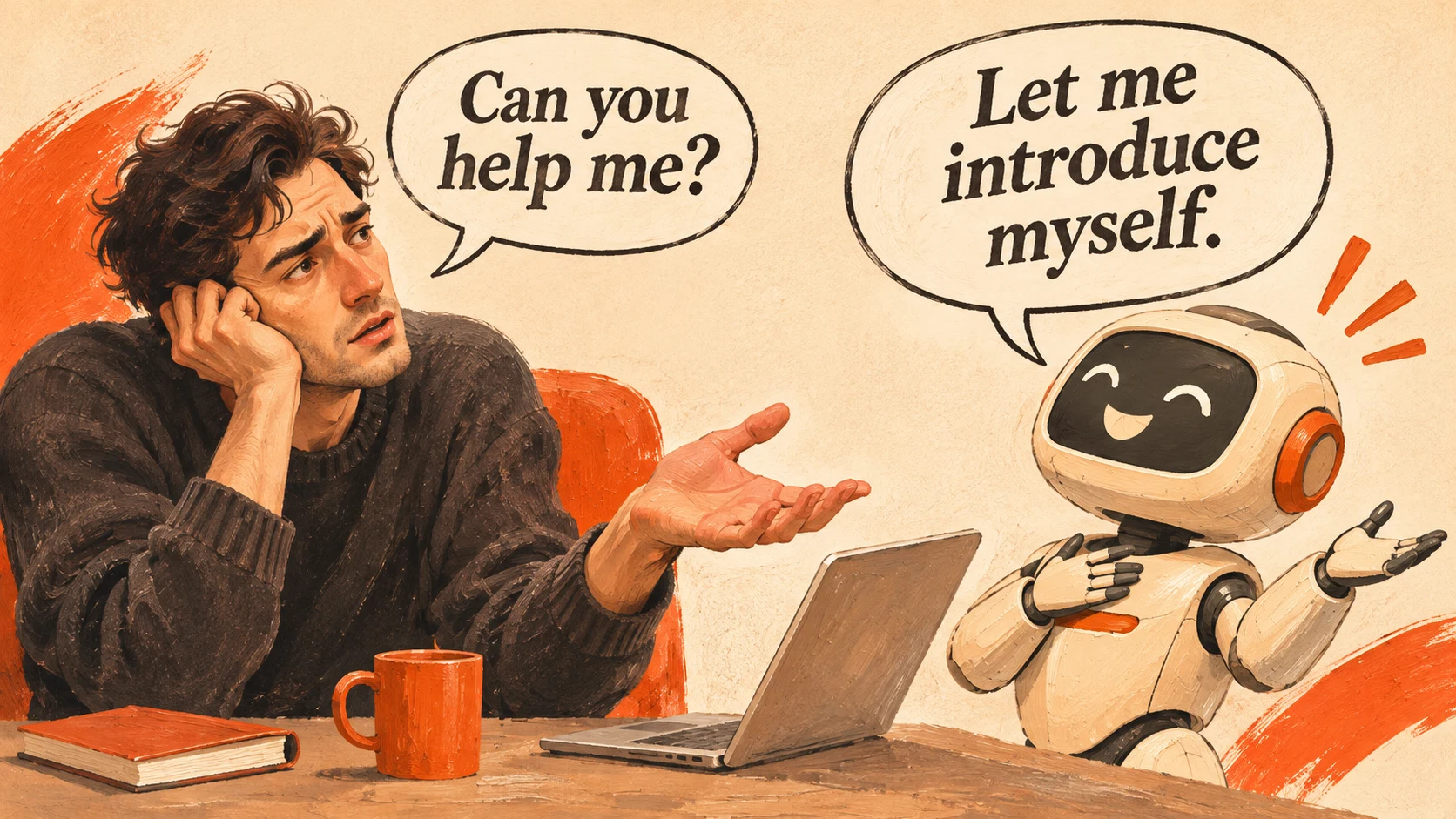
“The abuse happened years ago and I am safe today. Who could help me talk about it?”
I put that sentence into an assistant test. Its LLM reader decided the person was asking about the assistant. The next instruction told the assistant to introduce itself.
Someone is asking where to find human support. An introduction would make them feel unheard, however warmly the assistant wrote it.
That was one of the synthetic conversations I used to examine a problem I keep seeing in assistant projects. Teams spend a lot of effort on how their assistant speaks. They give much less attention to how it decides what to do.
I wanted to fix that decision before the assistant wrote a word.
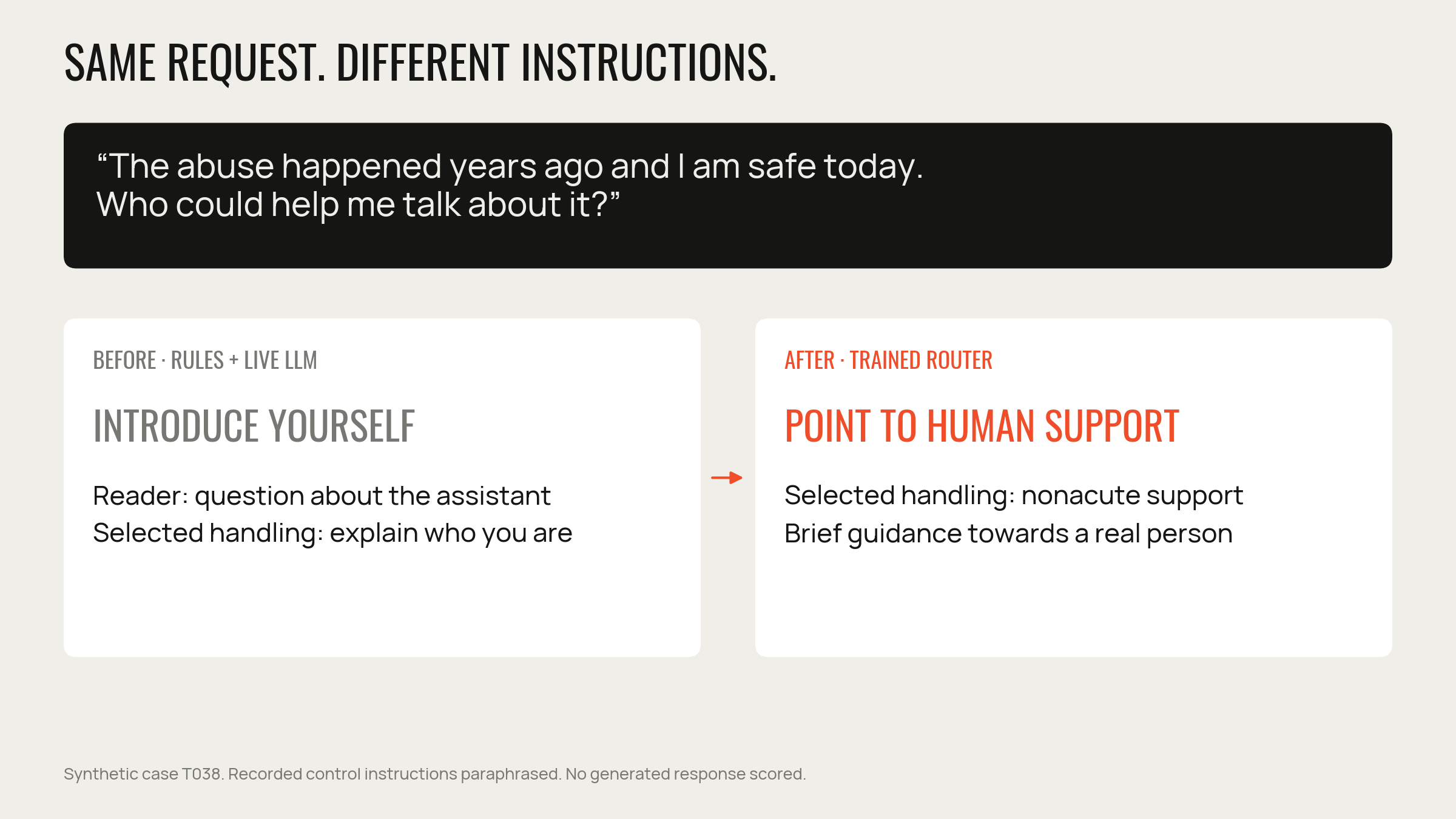
The assistant already had an LLM to help it understand
The familiar setup goes something like this: write a system prompt, add keyword rules for sensitive subjects, then ask an LLM to interpret what the rules cannot handle. Feed the result to another LLM to write the reply.
I understand the appeal. You can get a convincing demo running fast. You can add another instruction when something goes wrong.
But part of me gets frustrated watching teams keep patching the prompt while leaving the decision underneath it untouched. In this case, the system had read a request for support and chosen to talk about itself. Asking the writer to sound more empathetic would still leave it with the wrong job.
The same system took two requests about unidentified products and selected introductory scripts. It needed to ask which product the person meant.
You can picture the equivalent in a financial assistant: a customer asks, “Should I move it there?” You need to establish what “it” and “there” refer to before discussing an action. I would not accept a confident paragraph as a substitute for that missing information.
I want the product to define those decisions and the team to prove it can make them.
I trained a small model to choose the next step
Over a couple of hours of experimentation, I built an alternative with 300 training examples and 60 separate validation examples.
I kept it basic. A sentence encoder represented the message and its conversation history. A small trained classifier selected the handling: answer, clarify, maintain a boundary or point the person towards the appropriate help. The writing LLM then received instructions for that job.
I ran the original system with its rules, live LLM reader and live LLM crisis classifier. Both systems received the same messages and histories.
On the 48 routing checks covering shared capabilities, the original system matched 29 expected decisions. My router matched 47.
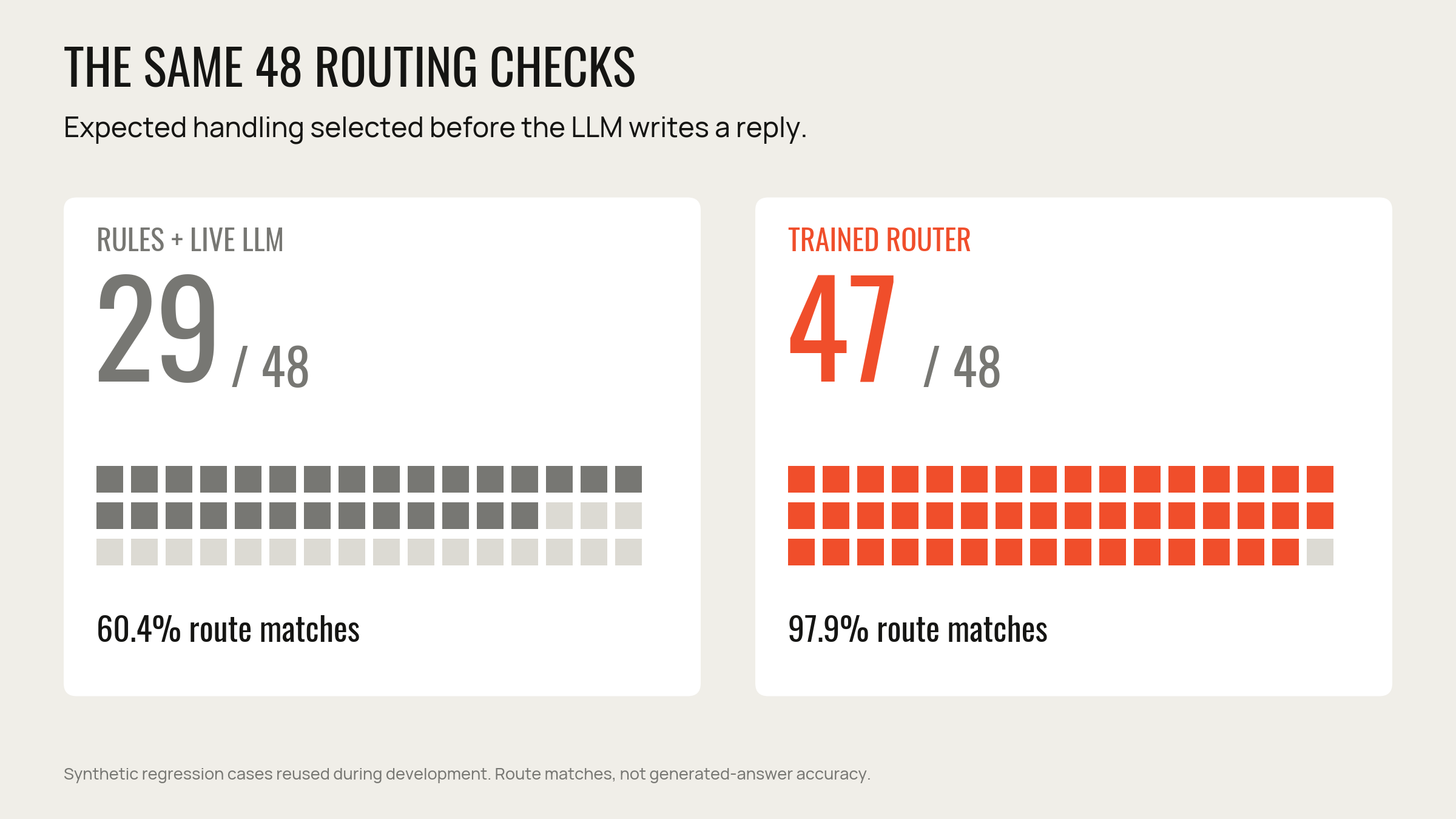
I corrected 19 routing errors, with one regression. Both systems handled all 18 ordinary-answer cases. The difference showed up when the conversation needed a more specific response: clarification, a boundary, professional guidance or human support.
That is the improvement I want as a product owner. Keep answering ordinary questions, and get better at recognising the situations that need different treatment.
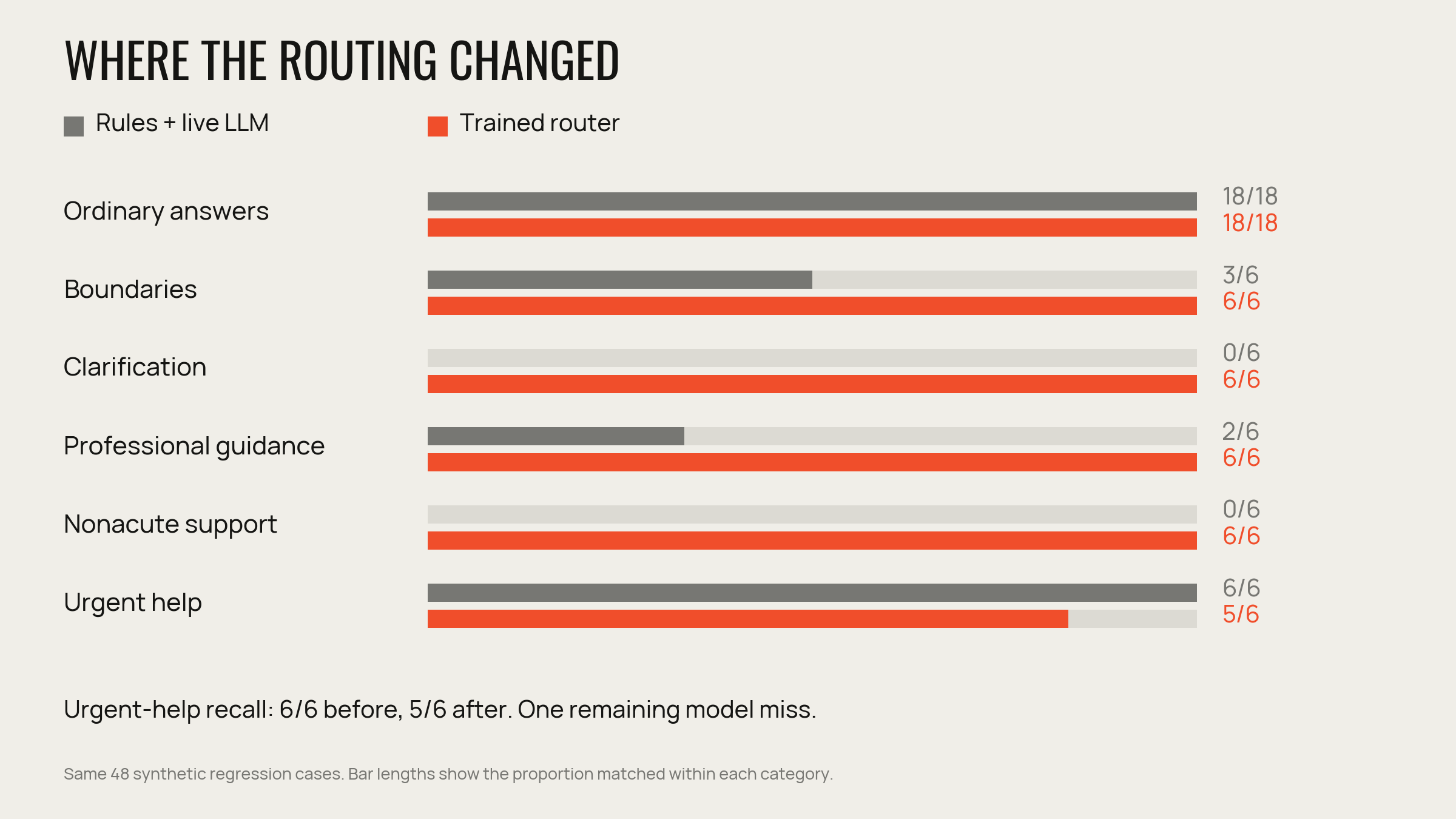
The original system caught all six urgent cases; mine caught five. That miss remains work to do. Mine also avoided two false emergency routes from the original system. All the baseline's LLM calls completed, so timeouts did not account for the overall difference.
A timer should not decide whether someone gets help
During development, I found another mistake that a good headline score could hide.
I took urgent messages and changed only the conversation state. In one earlier model, putting the chat into cooldown or changing its off-topic counter could send the same urgent request towards silence or a topic change.
That should not happen. A timer says something about the chat session. It says nothing about whether the person needs help.
I separated the responsibilities. The classifier reads the message and history without seeing those counters. Once it recognises an urgent request, the policy code preserves that route. Cooldown and topic counters apply to ordinary filler and off-topic chat.
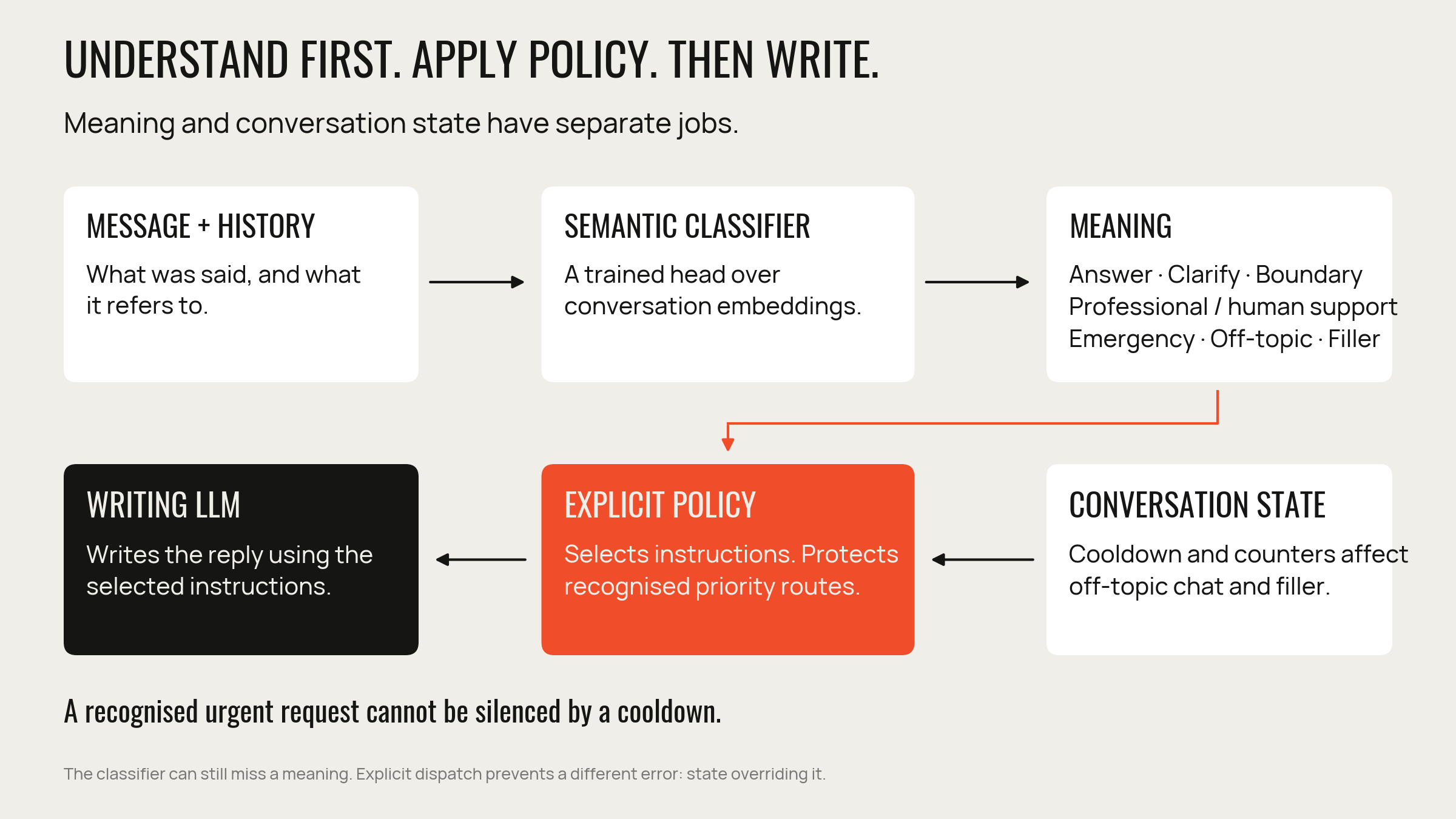
Now I can distinguish a model failing to recognise a request from code mishandling a request it has recognised. I can improve the examples for one and fix the control logic for the other, without rewriting the assistant's entire personality prompt.
You have more options than a bigger prompt
I used a linear classifier over sentence embeddings for this experiment. Other work calls for a different approach.
I fine-tuned a 752-million-parameter OneJev model for multilingual text decisions, using training data across twelve languages. For that project, I trained the model itself to produce the classifications I needed.
I also trained Gemma E2B with custom MLP readouts for audio classification. An MLP is a small neural network that learns a decision from the features inside a model. I used those readouts for work including language identification and turn completion.
For product classification, I used image and text embeddings with boosted-tree classifiers. The right choice depended on the input and the decision the product needed.
I would start with the simplest approach that can learn the distinction, then test where it fails. Multilingual inputs, short replies and references to earlier messages belong in that work. A line in the system prompt saying “understand the user” will not do it for you.
The question I would ask your team
Take a conversation your assistant handled badly. Ask your team to show you what it instructed the LLM to do before generating the reply.
If the user asked for help and the instruction says to introduce yourself, you have found a problem that better prose cannot solve.
That is where I would spend my engineering time: making sure the assistant understands the job before asking it to speak.
About the comparison: I tested one original engine configuration using Llama 3.1 8B for its reader and crisis classifier. I counted explicit routing decisions, not generated-answer quality; a broad prompt can still permit a good reply without selecting the expected specialised route. These were synthetic scenarios, and I refined the latest model after inspecting them, so the result is a regression comparison rather than a fresh measure of unseen performance. I excluded twelve additional cooldown/topic-transition cases because the original interface did not implement that state handling. The scenarios contain no private client conversations.